

Meet Oli from Woodforge UK
From forged steel sculptures inspired by moss-covered logs to hand-turned wooden bowls shaped on a pole lathe, June’s Maker of the Month, Woodforge UK, creates work deeply rooted in traditional craft and the natural world.
Artist blacksmith and greenwood worker Oli combines ancient techniques with a thoughtful modern perspective, exploring the balance between heritage skills, ecology and contemporary making. Influenced by everything from woodland management to material intelligence, his work celebrates texture, imperfection and the enduring connection between people, craft and the land.
In this interview, Oli talks about teaching himself to blacksmith in his back garden, the mesmerising pull of fire and steel, studying Artist Blacksmithing, and why traditional crafts still matter in an increasingly digital world.
To start, could you introduce yourself and tell us a bit about WoodforgeUK – who you are, what you make, and what led you into blacksmithing and craft?
Hello I’m Oli. I am a mixed media artisan with a focus on blacksmithing and greenwood working. I make forged steel sculptures and products. Also I enjoy carving and turning greenwood.
I think it started probably from seeing blacksmiths on the TV as a teenager (this was pre social media days!) My cousin and I were always burning bonfires in the garden and so I started heating bits of steel and trying to shape them with a hammer. From there I took an interest in blacksmithing by self teaching in the backgarden using books and YouTube videos. I even worked with a farrier briefly although this is a different craft focusing on horses.
In my twenties I did a couple of short courses at Woodland Pioneers in Cumbria with the Bill Hogarth memorial fund (Bill was a traditional British woodsman in the coppicing industry). This gave me a good grounding in traditional woodland crafts like the pole lathe turning, hurdle making, charcoal making and carving stools using greenwood.
Since then I have continued to learn as much as I can.

You’ve moved between ecological land management, traditional crafts, and artist blacksmithing – what first pulled you towards working with metal and fire?
There is just something so primordial about forging metal as it is such an ancient craft that developed in different ways around the world.
The flickering flames and dancing embers are so mesmerising and I wonder what our ancestors were thinking when they needed to create tools and ornaments in antiquity. The thought process, the challenges and solutions that they figured out which brought technology forward to the present day.
You recently graduated with a degree in Artist Blacksmithing, and as part of this you studied “The balance of Craft and Modern Technology.” How does that idea show up in your own making today?
Absolutely, that is the title of my dissertation. I wanted to compare traditional and modern in a balanced way, looking at the pros and cons of both. How traditional crafts would shape ecological landscapes, how industry, software and robotics certainly speeds up some processes but what of the impacts to our environment and human well being.

One of the many sources I researched included the book Craeft by Alexander Langlands (it is an interesting read I would recommend!)
I am traditional thinking and do use time honoured techniques and tools. However I will use modern equipment when I need to depending on the context. I am not a luddite!
For example I can join two steel bars by traditionally firewelding them. But I can also use a welder to do the same thing. Either method will do the job.


Working with the RSPB and being surrounded by nature clearly influences your work – can you share a piece you feel is most directly inspired by the natural world?
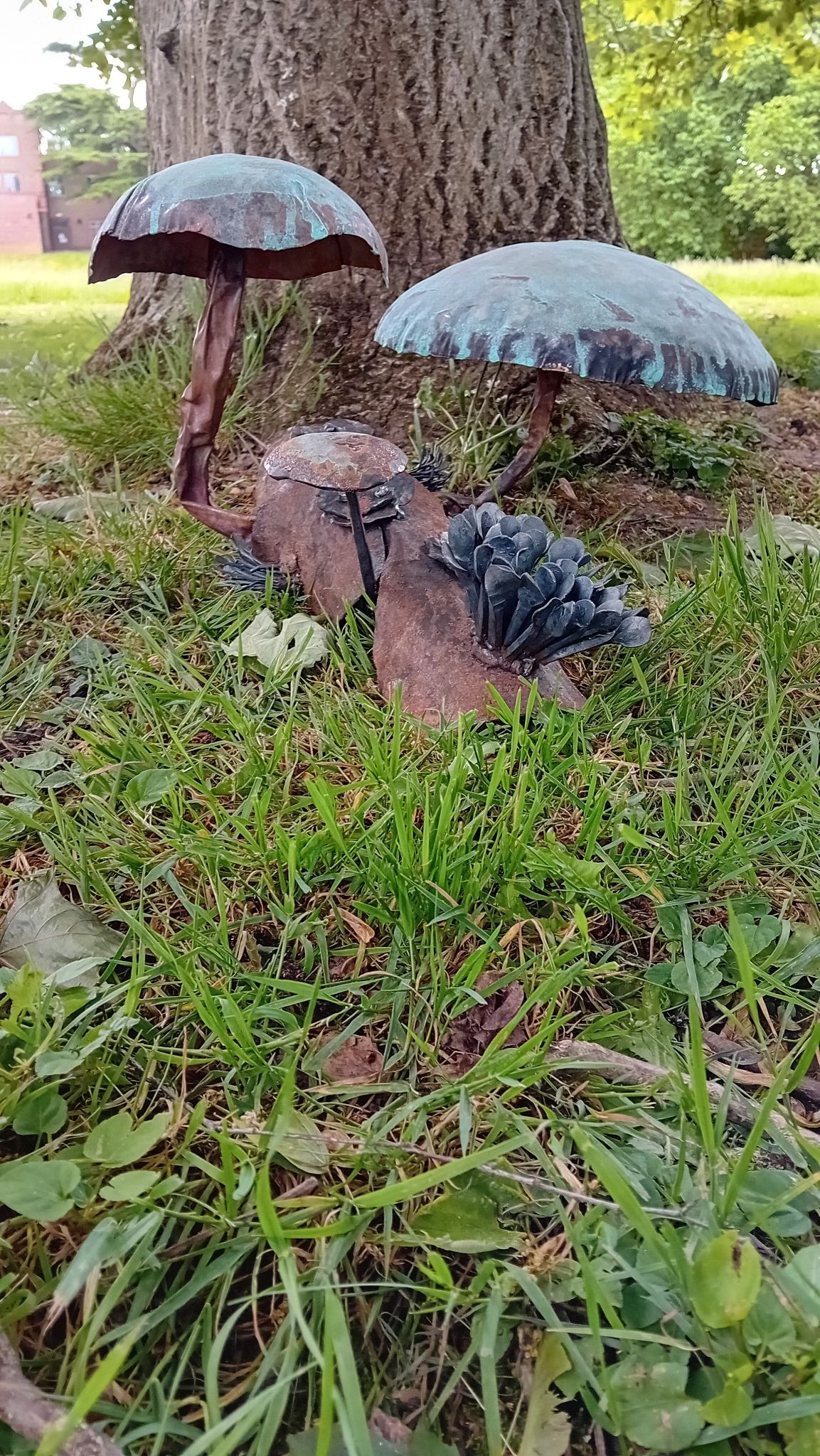
I once made a sculpture inspired by mushrooms and moss growing on an old log. I forged some thick steel sheet to look like tree bark, with cavities such as you would observe on a log on the forest floor. Smaller rods were welded together to resemble the structures of grasses and mosses growing on the surface.
The shrooms I chose to use copper and shaped these into toadstools with a little soldering. Finally I applied a surface patina causing a blue tinge and iron oxide to resemble a realistic organic surface.
Greenwood working, hedgelaying, blacksmithing… you’ve kept a strong connection to traditional land-based crafts. What do you think these skills give you that modern approaches don’t?
It’s important to work with nature as these crafts are part of our heritage.
We need to use them or we will lose them. Working with the land creates cycles of valuable materials. This type of management also benefits the various ecosystems in our countryside.


I’m certainly not against modern approaches as many of my friends are machinists and engineers. I take a fascination in how everything works or functions in modern technology and industry. But certainly I have a deep love of how things were made in the past but also continued today by various craftspeople and hobbyists.
You’re currently building towards setting up your own forge/workshop – what does your dream workspace look like?
I would be very content with a small work space with an anvil, forge, vise and worktable. Plus an area for a pole lathe and shave horse to continue to improve my skills and practice.


Looking ahead to my future business plan, I am keen to teach these crafts so these skills are not lost. A workspace is essential for this. We learn crafts by physically being shown and then trying them. There is only so much that books and Youtube can teach you!
Your recent forged sculptures will be exhibited at Fresh Air Sculpture 2026 – what are you exploring creatively in that body of work?
This is an exhibition set in a wonderful garden in rural Gloucestershire. One of my designs forged in steel is called ‘Germination’ which represents a central seed germinating with roots, shoots and leaves out of a ring.
It is open to interpretation but I can visualise it as a sphere with a core a bit like the fiery core inside the earth. It also explores a theme of crescents and circles. In a sense a circle of life of beginnings and the potential.
When you’re in the forge, what part of the process do you find most satisfying – and what part still tests you every time?
At University I took note of a term “Material Intelligence” by Glenn Adamson. By knowing the material you are using, how it is made up, its limitations and potentials you can then learn how it can be shaped skillfully.
Steel is very much like plasticine when heated to high temperatures and can be moved with the encouragement of a hammer. Shaping steel this way is very satisfying. The way you can give a surface an appearance to look natural or by contrast something contemporary or industrial.

While I am not very good at Maths and sometimes I find it very confusing it is part of daily life and craftwork. So I really have to take my time when figuring out dimensions or measurements to avoid mistakes. There’s that old saying measure twice – cut once!
Since it’s Father’s Day in June, we’d love your expert perspective for our Thoughtful Gift Edit campaign: what makes a really good handmade gift in your view, and how can buyers choose something meaningful rather than generic?
Something that is designed and created by human hands and certainly not AI produced.
Knowing the person’s taste, what appeals to them or what they would find amusing or quirky. Something different or unique that you don’t see every day. Something made with care and endearment.
If you were choosing gifts from your own collection this Father’s Day, what would you pick for:
- A practical, outdoorsy dad?
If they were an archer the ‘Wicker quiver’ or if they love gardening a ‘Garden gift set’

- A creative or artistic dad?
One of bowls either ‘Beautiful grain’ or ‘Wabi Sabi’ meaning to celebrate imperfections

- A dad who “already has everything”?
‘Scroll’ or ‘Rustic Doorstop’ as they are unique and I guarantee he doesn’t have one of these!

For someone discovering your work on Folksy for the first time, how would you describe what you do in three words?
Tactile, Handcrafted, Rustic
What role do you think handmade craft plays in today’s world, especially when so much is digital or mass-produced?
Craft is good for people’s mental health and well being. There is a pleasure and satisfaction gained from making something from a raw material whether it is textile, drawing, ceramics, or sculptural. Craft is craft.
We don’t want to go too far and lose what we have. In a way I compare digital and AI to the way agriculture was changed a hundred years ago by mechanisation. I’m not saying it was a bad thing to increase productivity and lessen the back breaking daily toil of physical labour but it certainly changed the rural community.
It is not to say that the older ways were more honest and benign and that all modern technology is completely soulless. Time and efficiency are valued which has led to technological advancements.
Traditional craft does have its place in a modern world but the artist needs to learn how to be diverse and adaptable to be ‘material intelligent’.
It is poignant to see that current environmental concerns were spotted before in previous centuries by people like William Morris. It is not just a modern trend or popular subculture.
Finding a middle ground where both forms of craft can be celebrated while being more benevolent to the environment would benefit the human mental and spiritual sense of being.
With due thought and consideration it can be done positively.
What’s something about blacksmithing that people are usually surprised to learn when they first see your work?
Everything burns if you get it hot enough including steel.
This tends to happen if you’re not paying attention and overheat your work in the forge with the air on full power. Good fire management is needed by learning where the ‘good spots’ are in a reducing fire.
When fire welding you’re aiming for a white heat where the steel is becoming slightly fluid and therefore can be fused to another piece of steel (takes a lot of practice to get this right!). If the temperature is too low it will not join. But heating above this critical temperature destroys the steel as the carbon burns away and your piece is ruined as it looks like a sparkler as its internal structure crumbles away before your eyes. Yep I’ve had a few accidents like this in the early days but this is how we learn from mistakes and improve our technique.

Finally, what advice would you give to someone who is aspiring to become a maker or craftsman in this space today – especially those drawn to traditional skills like blacksmithing?
Give it a go. Try a blacksmith experience day or self teach you don’t need expensive or fancy equipment to start. There are very good educational courses out there or the occasional apprenticeship and financial bursaries to help.
Figure out what you’re good at as everyone has their own way of doing (this applies to all crafts)
While the current recession is not helpful to the craftworld, I think just look at what’s gone before, things change and things will come around again.
Read, focus, listen, practice and be open minded. Learning never plateaus, there is always something else to try and experiment with.
Be prepared that you will make mistakes but always learn something from them. No one is perfect! Don’t take yourself too seriously just laugh about it.
But most importantly have fun and enjoy the craft!

